Attitude control, pointing and robustness
Inspect control authority in the Console
Choose Sizing and budgets > ADCS. The Symmetric deployable arrays starter records a four-wheel architecture, so its native sizing result supports both nominal and individual wheel-out inspection.
Read the nominal device allocations
Select payload pointing under Sizing scenarios and Nominal under Actuator condition. Compare demand with capacity in Wheel torque, Wheel momentum / mission cycle and Magnetic dipole / mission cycle. Open Allocation sources when you need the source of a particular comparison.
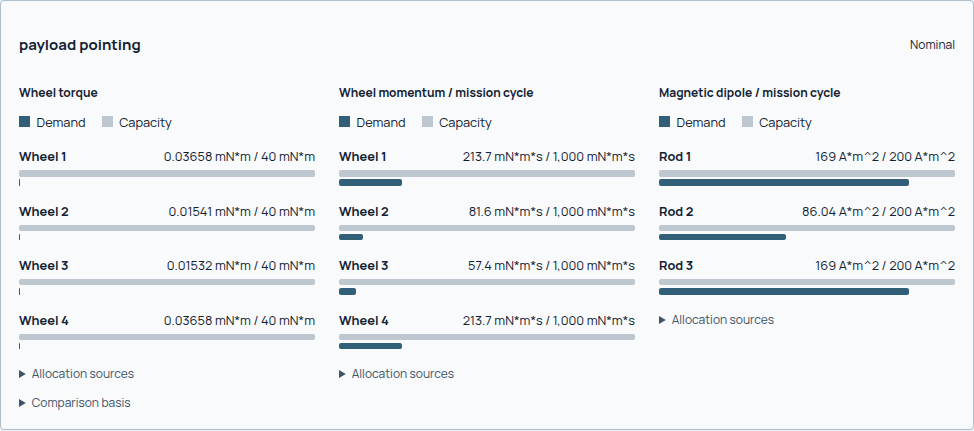
The captured nominal wheel-momentum demand reaches 213.7 mN·m·s per governing device against 1,000 mN·m·s capacity. Device peaks can come from different allocations; they are not simultaneous body-axis requirements.
Compare a wheel-out condition
Choose Wheel 1 out while keeping the same scenario. Inspect the changed device demands and retained capacities, then open Comparison basis. Review the scenario's checks below the plots rather than treating the global margin headlines as the complete acceptance result.
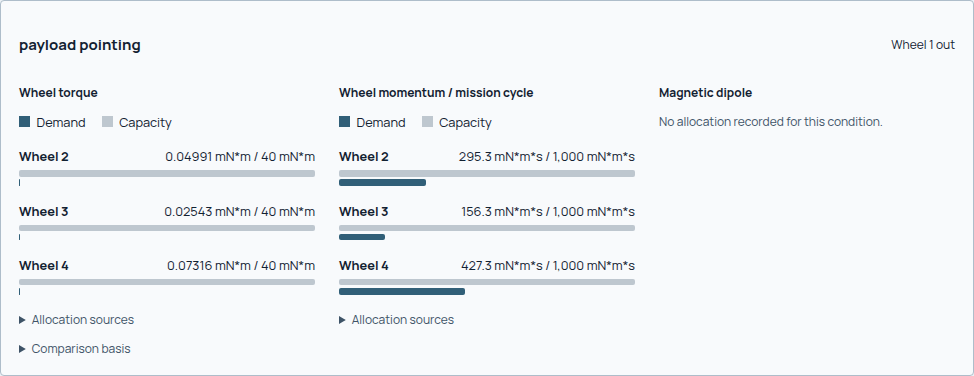
This control inspects a recorded wheel-out allocation. It does not mean the magnetic actuators were re-assessed under that same failure condition.
Trace the governing load and pointing checks
Read Governing loads, expand Body-axis components and sources, then compare Body-axis requirements and Native pointing budget. The operating mode and configuration identify the physical case. A scenario's Check detail shows the requirement or built-in screening basis behind its status.
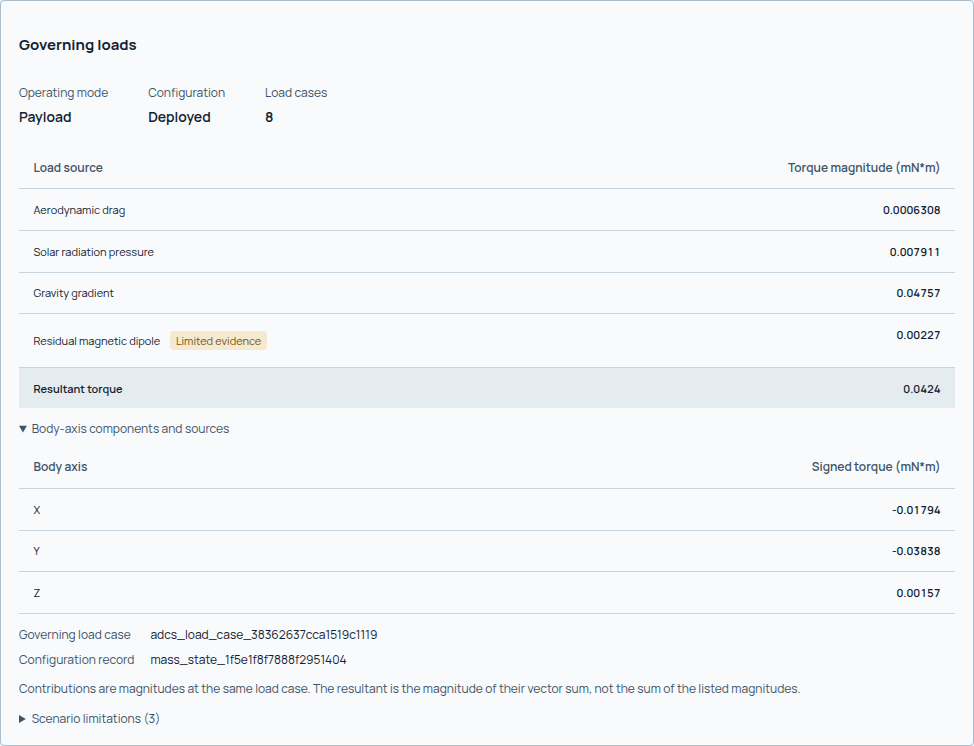
Gravity-gradient torque has a magnitude of 0.04757 mN·m here, while the resultant is 0.0424 mN·m. Add the signed vector components on a common frame; summing the displayed source magnitudes would give a different quantity.
Match control hardware to the represented demands
Start with the axes and scenarios that drive control demand. Native ADCS sizing screens sensor and actuator choices against static disturbances, momentum and the configured pointing requirements. Inputs include state-specific mass/inertia, geometry-derived areas and CG lever arms, environment, sensor assumptions, wheel/magnetorquer capabilities, slew/unloading durations and pointing limits.
Torque uses N·m, angular momentum N·m·s, inertia kg·m² and magnetic dipole A·m². A wheel speed in rpm is not a momentum capacity without rotor inertia. Frames, axis directions and measurement/statistical definitions must remain consistent.
The optional architecture presets adcs_three_wheel_arch_v1 and
adcs_four_wheel_arch_v1 declare, respectively, orthogonal nonredundant and
tetrahedral one-wheel-out layouts. adcs_three_wheel_fixed_array_arch_v1 pairs
the first layout with body-mounted panels. Each includes three magnetorquers,
a star tracker, gyro and magnetometer; add the appropriate hardware when a
scenario requires other sensors, such as a coarse Sun sensor.
Declared axes seed the first inventory selection. Subsequent sizing uses actual installed axes; failed placement is not repaired by inventing another layout. Selected actuator and sensor masses feed placement and the mass budget directly. An explicitly selected undersized device retains its known mass but fails ADCS; an unresolved required device makes the budget incomplete. Final native ADCS checks use the delivered mass properties. An incomplete mass basis prevents normal launch assessment and 42 handoff rather than silently validating a subtotal.
Physical authority and pointing budgets
Force \(\mathbf F\) applied at a lever arm \(\boldsymbol\ell\) from the CG produces the torque vector:
Geometry provides that lever arm; the disturbance model supplies the force/coefficient assumptions. Wheel allocation evaluates directional torque and momentum authority, while magnetic control depends on dipole, field and geometric authority. Comparing only a scalar wheel capacity can hide an axis that lacks sufficient control.
Pointing is an explicit deterministic budget. Nonnegative terms are combined by root sum square in arcseconds and converted to degrees using 3600 arcseconds per degree:
Each \(\theta_i\) is a nonnegative budget contribution in arcseconds.
| Metric | Included budget terms |
|---|---|
| Knowledge error (AKE) | Sensor noise/alignment, gyro propagation and orbit knowledge |
| Absolute pointing error (APE) | AKE plus control, actuator residual, structural and disturbance-rejection terms |
| Relative pointing error (RPE) | Wheel jitter/ripple, gyro random walk and control terms |
| Mission pointing error (MPE) | APE plus mission reference error |
Retain the metric-definition version, fidelity mode, term sources and warnings. RSS aggregation does not establish that a published RMS/3σ/time-window metric is equivalent. Native static authority can modify an actuator-residual assumption; it does not synthesize a validated closed-loop attitude history.
Robustness studies
Use Design Studies for explicit cases, grids or seeded samples under one confirmed allowance. The native ADCS evaluator replays one case from verified nominal state. Its default physical profile varies inertia, drag/solar-pressure coefficients, residual magnetic dipole, atmospheric density, solar flux, projected area and slew duration within recorded bounds. Unsupported variable paths are rejected; output-margin scaling is not a physical perturbation.
Native ADCS sizing response can choose different hardware. Keep it distinct from fixed-hardware scenario qualification and from specialist 42 dynamics. Inspect the exact plan, case completion, execution/assessment states, governing scenarios and demand/capacity rows. A passing fraction from stratified screening is not a failure probability for the real spacecraft. Preserve seeds, bounds and failed or incomplete outcomes when comparing experiments.
Old embedded adcs_robustness_v2 runs remain readable historical evidence. New
execution uses the shared study engine and does not reinterpret an old aggregate
as current robust eligibility. See native ADCS preparation.
Specialist 42 handoff
The optional local 42 interface translates a resolved design into indexed, digest-pinned case inputs. It requires a successful ADCS source result. Handoff validation checks schema/interface version, snapshot, source lineage and files; it does not run the external simulator.
An external executable is obtained and qualified separately. A replay uses a fresh workspace, records executable identity and output digests, and leaves the source bundle immutable. Missing/malformed outputs or process failure remain explicit. Fixture replay verifies the adapter, not dynamics produced by an actual local 42 executable. There is no promise of one-to-one equivalence for every subsystem or a qualified controller.
Review and limits
Read the ADCS result and
robustness result with
scenario assumptions, inertia and hardware authority. A not_assessed aggregate
must not become a blanket pointing pass. The completed illustrative studies do
not establish flight fine-pointing performance.
Detailed control stability, flexible dynamics, high-frequency jitter and mission-specific sensor behavior require matching evidence and specialist analysis. See operating workflows for the project entry point, and preserve all evidence when escalating a specialist case.