Propulsion and maneuver delivery
Read a maneuver budget in the Console
Choose Sizing and budgets > Propulsion. In the Symmetric deployable arrays starter, follow Orbit raising from its authored demand to stored propellant and elapsed delivery time.
Establish what the mission budget includes
Read Mission delta-v budget, then select Orbit raising in the allocation plot or Mission allocations list. Check both its value and its ownership. An allocation marked Excluded is outside this budget, rather than a maneuver the system has independently shown to be unnecessary.
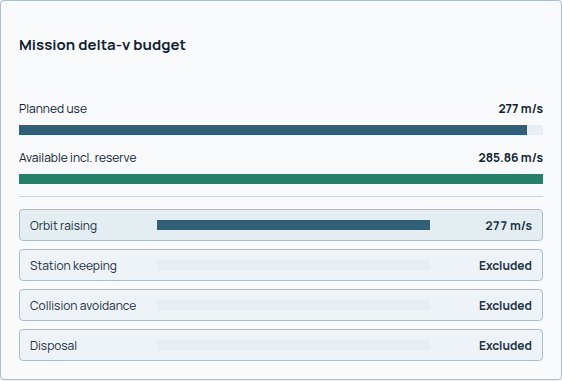
This study authors 277 m/s for orbit raising and records 285.86 m/s available including reserve. Station keeping, collision avoidance and disposal are excluded from this particular budget.
Reconcile loaded mass and tank capacity
In Propellant budget, distinguish mission-usable propellant, reserve and unusable residual. Compare Required storage volume with Installed usable tank volume before following the selected tank into Architecture.
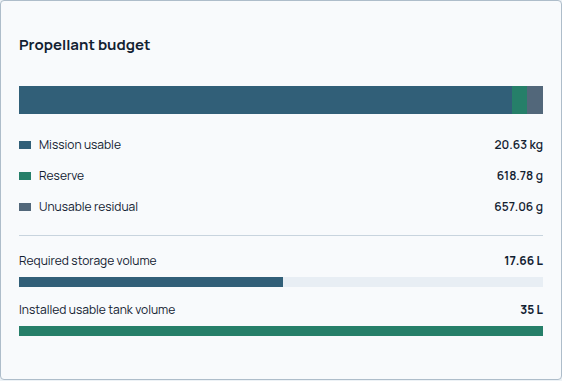
The composition includes 20.63 kg mission usable, 618.78 g reserve and 657.06 g unusable residual. Storage needs 17.66 L against 35 L of usable tank capacity. Tank capacity and delivered mission delta-v are separate checks.
Inspect delivery, not just stored propellant
Read the selected allocation's sizing and delivery table and Delivery duration plot. Keep Thruster active time, Elapsed delivery time and Effective delivery duty separate. Then review Propulsion sizing checks for time, power and cycle energy, followed by Still to qualify.
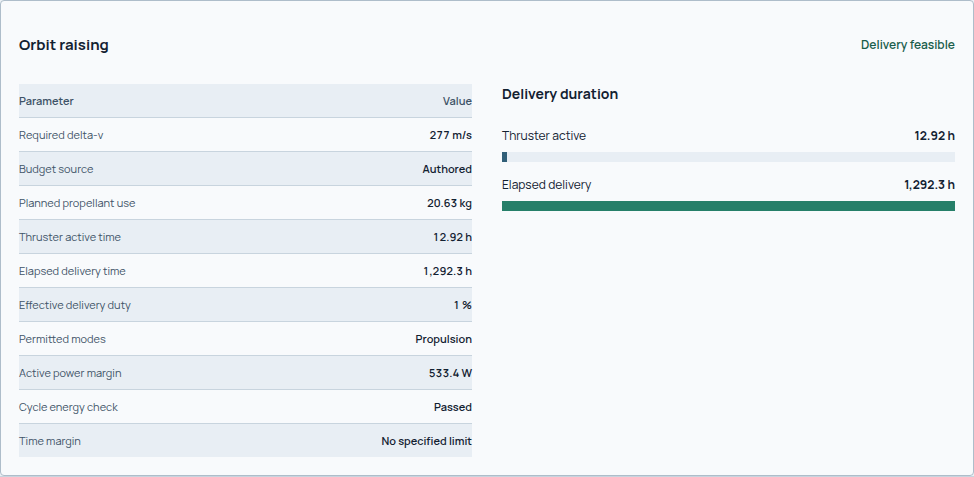
Here 12.92 h of thruster activity spans 1,292.3 h at 1% effective duty. The delivery-time check is Not assessed because no time limit was specified. Those hours describe the modeled maneuver, not the solver's runtime.
Check both propellant and maneuver delivery
Carrying enough propellant is only part of the design. The selected thruster must deliver the maneuver within its allowed operating time and electrical budget. Read allocation, hardware, tank capacity and delivery margins together.
Define allocations for orbit raising, station keeping, collision avoidance and disposal. Each records whether its delta-v (m/s) is authored, derived or not applicable. Select compatible assembly, propellant and tank resources; record specific impulse (s), thrust (N), propellant density (kg/m³), reserve/residual policy, permitted operating modes and any category delivery-time limits (s). A zero allocation does not bypass hardware selection or represent a completely absent propulsion subsystem.
Demand and mass closure
A bounded drag case uses:
Here \(\rho\) is atmospheric density, \(v\) relative speed, \(C_{\mathrm D}\) drag coefficient, \(A_{\mathrm{ram}}\) projected ram area, \(m\) spacecraft mass and \(\Delta t\) integrated duration.
With SI inputs, force is N and delta-v is m/s. The ram area comes from the bound geometry/state and the density from the selected environment case. This is a bounded constant-case estimate, not continuous orbit decay or a reconstructed maneuver history.
The sequential maneuver calculation uses the rocket equation:
Specific impulse \(I_{\mathrm{sp}}\) is in s and \(g_0\) is standard gravity.
Mass is kg and standard gravity is m/s². Dry spacecraft and propulsion hardware are accounted for separately at this boundary; upstream integration must avoid counting the hardware twice. Consumable propellant, retained reserve and tank residual are closed together, then the maneuvers are evaluated in sequence. Loaded propellant equals usable plus reserve plus residual, and required tank volume equals loaded mass divided by propellant density.
Recorded mass fields
PropulsionResultPayloadV2.mass records these separate contributions at its mass
boundary, all in kg:
| Field | Definition |
|---|---|
dry_spacecraft_mass_kg |
Dry spacecraft input excluding the selected propulsion hardware. |
dry_propulsion_hardware_mass_kg |
Resolved propulsion hardware, including assembly, tank and balance of system. |
loaded_propellant_mass_kg |
Usable propellant plus retained reserve and residual propellant. |
mass_states[].spacecraft_mass_kg |
Total spacecraft mass at the named maneuver state, including both dry contributions and propellant remaining at that state. |
Total dry mass at this boundary is dry_spacecraft_mass_kg +
dry_propulsion_hardware_mass_kg. A propulsion hardware fraction of total dry
mass divides the hardware contribution by that sum. BOL mass includes loaded
propellant; subsequent states include the propellant remaining after the
applicable depletion steps. These are local propulsion closure quantities;
the integrated mass result retains its own convergence and budget boundary.
Read depletion steps and BOL/operational/pre-disposal/EOL mass states. Reject a reserve/residual policy that cannot close the requested mass ratio rather than accepting an unbounded mass or overflow.
Time and power
For the selected fixed thrust and specific impulse:
\(\dot m\) is propellant mass flow in kg/s and \(d_{\mathrm{eff}}\) the effective duty fraction. Both times are in s; delivery requires \(d_{\mathrm{eff}}>0\).
Only EPS segments whose mode both permits propulsion and sets
activities.propulsion: true supply maneuver availability. Permission alone
leaves the hardware at standby power and heat. Activity in a non-permitted mode
is rejected. The effective duty is the active segment fraction multiplied by
the assembly duty ceiling within those segments. EPS and thermal share the
resulting mission-averaged operating fraction, with standby outside it.
The calculation checks delivery-time, thrust, electrical and lifetime activity
capacity. Missing or insufficient activity for required delta-v produces
propulsion.activity.unsatisfied, retaining the delta-v, selected hardware and
propellant requirement. With no scheduled activity there is no finite delivery
time, so delivery rows are absent. A total category delivery-time limit is not
the same as a per-burn wheel-saturation constraint.
Recorded delivery fields
The PropulsionResultPayloadV2.delivery rows use the fixed-thrust method.
Let a be the duration of active and permitted
segments divided by the complete timeline duration, d the assembly's
maximum_duty_cycle, and L the design lifetime in seconds (365.25 days per year).
| Field | Definition and unit |
|---|---|
active_time_s |
Consumed maneuver propellant divided by fixed mass flow, in seconds. |
elapsed_time_s |
active_time_s / (a * d), in seconds. The scheduling denominator is active-mode availability times the hardware duty ceiling. |
permitted_mode_duty_fraction |
min(active_time_s / (L * a), d), dimensionless. Required utilization of permitted lifetime time, capped at the hardware ceiling; used in mission-averaged operating loads. Its denominator differs from active/elapsed delivery duty. |
timing_margin_s |
Authored category delivery-time limit minus elapsed_time_s, in seconds. Null means that no category limit was authored. |
power_margin_w |
Minimum permitted-segment baseline power margin minus active thruster and balance-of-system power, in W. |
energy_feasible |
Complete-cycle recharge is at least minus the EPS tolerance and every permitted segment has at most 1e-6 W unserved load. |
controlling_segment_id |
The permitted segment with the lowest power margin, breaking ties by unserved load and segment identity. |
feasible |
Power and energy checks pass, and any authored delivery limit passes. Insufficient lifetime activity capacity also sets this false. |
Lifetime activity capacity is L * a * d; the activity margin subtracts the sum
of all maneuver active times. The capped utilization field alone does not prove
that this capacity is sufficient. EPS feasibility is assessed separately from
the elapsed-time equation. Zero propellant consumption gives zero active and
elapsed times; allocation ownership and demand describe why that category is zero.
The legacy propulsion.delivery-time-margin_s scalar is zero with controlling
source propulsion.no-delivery-limit when no category has an authored limit.
The typed delivery rows retain null in this case.
The propulsion assessment assigns fail if architecture resolution fails,
any delivery is infeasible or any margin fails. Otherwise it assigns warn if
any downstream handoff is open, and pass if none is open. Applicability describes
the method's coverage separately. This rule describes this implementation;
historical evidence must retain its own recorded method and status.
Electric propulsion demand feeds operating loads and EPS; propellant/hardware
feed mass; ram geometry affects derived drag demand. Read these coupled
assessments together, especially when the integrated run completes with a
propulsion fail, as the worked studies do.
Output and limits
The propulsion result retains allocation ownership, resolved architecture, mass/depletion, delivery margins, constraints and sources. Check tank volume and hardware applicability as well as total delta-v.
The fixed-performance calculation does not establish thrust-vector control, burn-by-burn wheel unloading, detailed finite-burn orbit dynamics, propellant management or flight qualification. A hydrazine thruster, xenon resistojet and butane cold-gas assembly are not interchangeable merely because each produces thrust. Mission reconstructions need matching hardware and supported physics.
Continue with ADCS for disturbance/control requirements or power for permitted-mode energy closure.