EX02: compact electric spacecraft
All examples and learning routes
Follow a 5 kg, 20/35 W payload through a compact electric-propulsion study. This CLI example uses the same inputs as EX08, including its 0.9 × 0.7 × 0.7 m bus and 60 m/s maneuver allocation. It is not a CubeSat packaging claim. Expect a complete evaluation with warnings, complete placement, and matching CAD when FreeCAD is available.
Prepare and run
Download EX02, extract it, then run from EX02:
sindri validate-project baseline/study.yaml
sindri run baseline/study.yaml --output-root runs
Use a compatible runtime. Keep the original run and inspect CAD availability separately from native execution.
Follow the coupled budgets
The reference Hall system supplies 2 mN at 800 s specific impulse and 60 W. Its thruster, balance of system and tank total 2.05 kg before propellant under Sindri's integration assumptions. The hardware explanation distinguishes these estimates from supplier evidence.
Inspect Propulsion, then Power and Thermal. The payload rating does not bound total bus power: the conservative safe-mode heater case is about 400 W. That is why the example retains the microsatellite PCDU. Its 900 Wh, 15 kg reference battery is deliberately conservative. A 160 Wh candidate closed the electrical model in a trial but exposed a gap in the available separation-system mass/interface ratings; it is not presented as a qualified replacement.
The two fixed panels explicitly use a 9:7 aspect ratio to fit the bus's 0.9 × 0.7 m side faces as the coupled electrical load resizes their area. This changes panel proportions only. The original default proportions fail placement with the current selected hardware loads and remain a regression case.
In Spacecraft, inspect fixed-panel face orientation, the exterior radiator, internal decks and the separation interface. Follow every unresolved warning before interpreting the complete score as an engineering conclusion.
Verified results
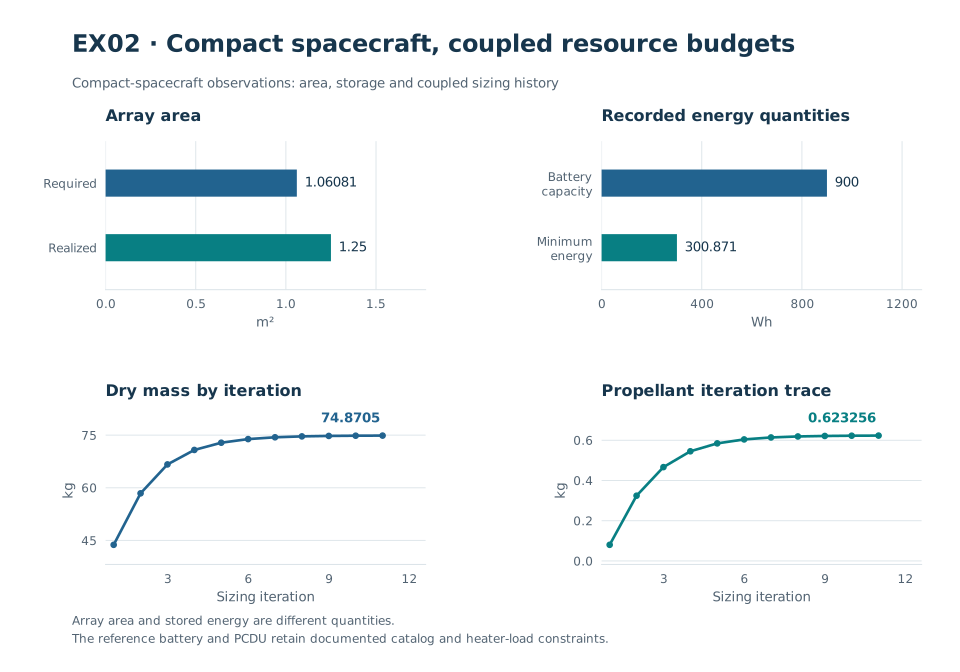
Array area, stored energy, dry mass and propellant are separate coupled quantities. The retained reference battery is intentionally conservative; read the hardware rationale and the remaining model limitations.
The following values are generated from the verified observations. Read the assessment states before treating any reported quantity as a usable design budget.
baseline — run lifecycle: completed.
| Quantity | Observed value | Unit |
|---|---|---|
| Nominal dry mass | 74.9027 | kg |
| Required solar array area | 1.06081 | m² |
| Realized solar array area | 1.25 | m² |
| Minimum state of energy | 300.871 | Wh |
| Peak heater electrical power | 315.11 | W |
| Radiator area | 0.716052 | m² |
| Loaded propellant | 0.62387 | kg |
| Total delta-v | 60 | m/s |
| Communications hardware mass | 1.15 | kg |
| Battery capacity | 900 | Wh |
| Reported cost estimate (base) | 3.73932e+06 | USD (2025) |
Full result states, diagnostics and provenance.
A useful next experiment
Change the maneuver allocation while holding hardware and the representative 75° beta-angle environment fixed. Compare thrust duration, propellant, electrical energy and the resulting mass. A later hardware trade should include launch interface compatibility as well as battery capacity.
See shared example limits and Next: EX03 · Larger-payload study.