EX01: your first microsatellite design
All examples and learning routes
Run an 18 kg Earth-observation payload through coupled sizing, inspect its physical layout, then read its engineering evaluation. This is the command-line route to EX07 · Microsatellite baseline: both use the same maintained inputs. The expected result is a completed run, a complete numeric evaluation with warnings, and no unplaced hardware or known geometry mismatch.
Prepare and run
Download EX01, extract it and open a terminal
in the EX01 folder. Use a compatible runtime and FreeCAD installation.
The archive contains editable inputs and resource checksums, not an installer.
sindri validate-project baseline/study.yaml
sindri run baseline/study.yaml --output-root runs
sindri status RUN_DIRECTORY --json
Replace RUN_DIRECTORY with the printed path. Preserve the inputs and original
run when trying a change. CAD is enabled; if FreeCAD is unavailable, sizing can
finish but CAD fidelity remains unassessed.
Understand the three input documents
| Document | Decisions to inspect |
|---|---|
mission.yaml |
Orbit, representative 75° beta angle, mode durations and the 255 m/s maneuver allocation |
spacecraft.yaml |
18 kg payload, 90/150 W payload demand, fixed panels, chemical propulsion and the 2.0 × 0.8 × 1.2 m bus |
study.yaml |
The two document references, seed, native pipeline and CAD output |
The study connects the two input documents through paths relative to itself.
Each document_id must match its referenced document. Retain the seed when
comparing designs.
mission:
  document_id: mission.r6-core-packaging-baseline
  project_path: mission.yaml
spacecraft:
  document_id: spacecraft.r6-core-packaging-platform
  project_path: spacecraft.yaml
seed: 123
Payload quantities and per-item demand are separate inputs:
payloads:
- payload_id: payload.eo-core-packaging
  name: EO-Core-Packaging
  quantity: 1
  mass_each_kg: 18.0
  average_power_each_w: 90.0
  peak_power_each_w: 150.0
These are checked excerpts from the download, not complete replacement documents.
The bus is a deliberately generous reference envelope for the integration lesson. It is not a volume-minimized design. Its low equipment-proxy occupancy excludes many installation details; the unfilled preview is not a literal empty-volume budget. The compact electric example is a separate mission, not a scaled copy.
Inspect the outputs
- Open the run in the Console. In Overview and Evaluation, distinguish completion, eligibility and remaining engineering warnings.
- In Power, inspect required versus realized panel area, battery energy and recharge. Payload demand is only part of the load: heaters, propulsion and communications also matter.
- In Spacecraft, hide the bus envelope to inspect the physical decks and equipment. Fixed panels should lie outside their supporting faces. The launch adapter belongs against the outside of the bus, and harness openings cut the decks.
- Read Mass, Propulsion and Launch together. The mass budget is complete under its selected reference policies; that is not an independent calibration.
The Console tour shows the tables, issues, scores and investigation tools. Geometry and placement explains which shapes are envelopes and which represent occupied material.
Verified results
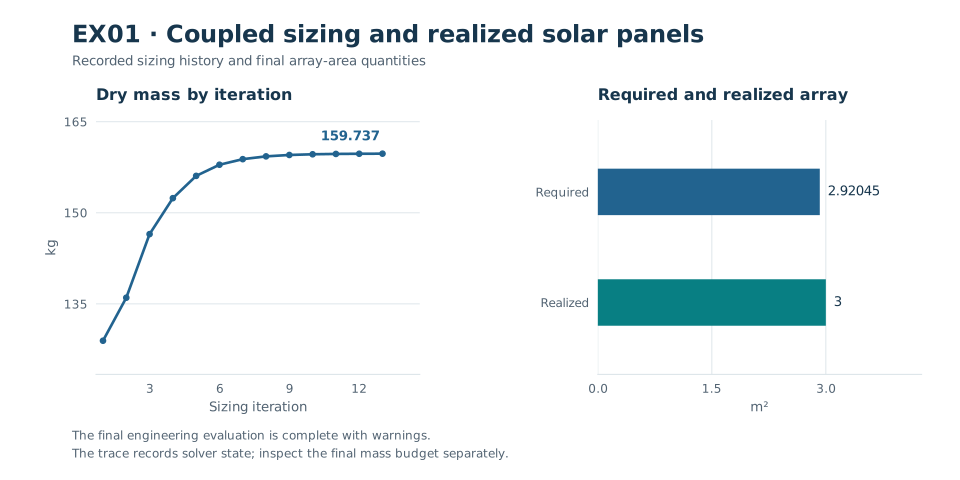
The actual sizing trace and final required/realized array areas describe the same coupled study. The engineering assessment is complete with warnings; this is a concept baseline, not flight qualification.
The following values are generated from the verified observations. Read the assessment states before treating any reported quantity as a usable design budget.
baseline — run lifecycle: completed.
| Quantity | Observed value | Unit |
|---|---|---|
| Nominal dry mass | 159.751 | kg |
| Required solar array area | 2.92045 | m² |
| Realized solar array area | 3 | m² |
| Minimum state of energy | 185.15 | Wh |
| Peak heater electrical power | 442.441 | W |
| Radiator area | 0 | m² |
| Loaded propellant | 20.4555 | kg |
| Total delta-v | 255 | m/s |
| Communications hardware mass | 4.85 | kg |
| Battery capacity | 900 | Wh |
| Reported cost estimate (base) | 8.3139e+06 | USD (2025) |
Full result states, diagnostics and provenance.
Change one assumption
Duplicate the project, change payload average power, and run again. Compare the array, stored energy, heater coupling, mass and assessments. A higher score alone does not establish a better mission. Do not remove a requirement to make a case pass.
This reference uses momentum unloading for 3,600 seconds per 5,400-second interval and one representative environment. Reassess changes to orbit, beta angle or operating modes. See example limits.