System sizing and convergence
Review completion and assessment together
Open Overview for a completed run and expand Assessment coverage. The Symmetric deployable arrays starter shows why the execution banner is only the beginning of a design review.
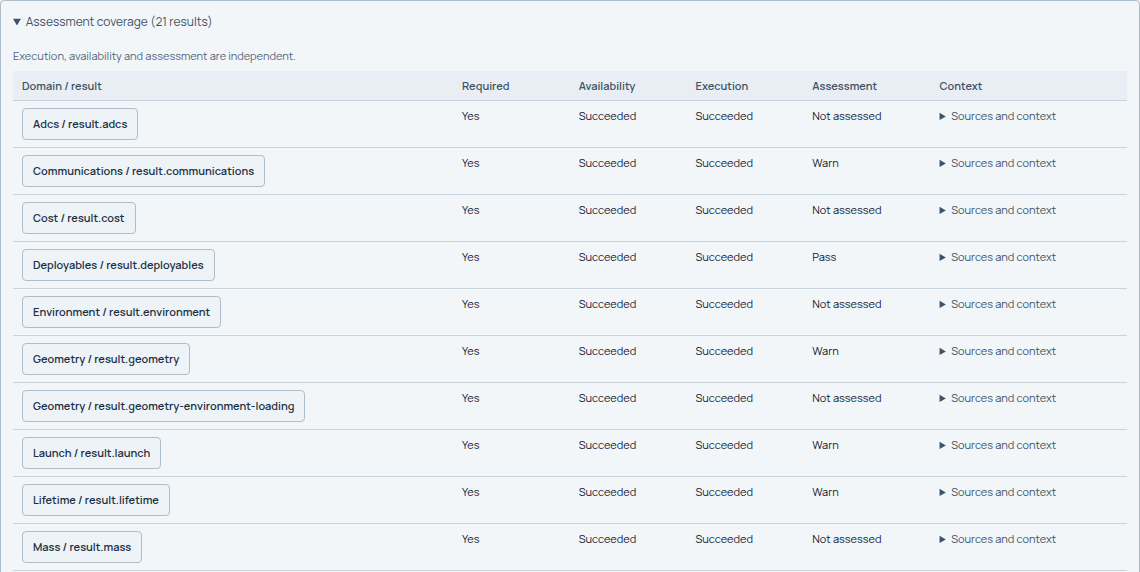
The captured Communications row has succeeded availability and execution with a Warn assessment. Deployables has a Pass assessment; Mass is Not assessed. Reading across each row keeps these different conclusions attached to their source.
Select a Domain / result entry to open its recorded checks, or expand Sources and context for its provenance. Use Sizing and budgets to inspect the physical quantities behind a subsystem conclusion, then follow a finding through the result-reading sequence.
For iteration behavior, review the convergence result and retained trace as described below. A stable trace, a completed calculation and a passing engineering assessment answer separate questions.
Why the design needs an iteration loop
A spacecraft budget changes as its hardware and layout take shape. More heater demand changes electrical sizing; that changes hardware and mass; geometry and mass distribution change loading and control demands. Sindri iterates these coupled quantities within the mission, spacecraft and study policies you author.
Before assessing closure, record the mission modes, hardware/resource versions, seed, allowed candidates, selection/freeze policies, iteration limit and convergence settings. A different allowed set can change the selected design even if the mission requirements remain identical.
flowchart TD
    accTitle: Coupled spacecraft sizing loop
    accDescr: Environment and current subsystem budgets feed embodiment, geometry loading and updated subsystem calculations. Selected quantities are damped and checked for convergence and selection readiness before the final assessments are reviewed.
    CONTEXT["Environment and current subsystem budgets"] --> EMBODY["Geometry, placement and hardware"]
    EMBODY --> LOAD["State-specific geometry loading"]
    LOAD --> UPDATE["Updated subsystem budgets and constraints"]
    UPDATE --> DAMP["Damp selected system quantities"]
    DAMP --> CHECK{"Convergence and selection ready?"}
    CHECK -- "Yes" --> RESULT["Review final results and assessments"]
    CHECK -. "No: iterate within the configured limit" .-> CONTEXT
This diagram groups the coupled calculations by purpose; it does not prescribe a separate execution schedule. Reaching the iteration limit can leave closure unresolved, and meeting convergence does not make failed assessments pass.
Iteration and selection
The calculation progresses through environment and subsystem estimates, physical embodiment/placement, then geometry-dependent loading and updated subsystem estimates. Selected state quantities use damping:
Here \(x_k\) is the previous state, \(\widehat{x}_{k+1}\) the newly calculated candidate and \(\alpha\) the damping factor.
The damping factor is dimensionless; previous and candidate must describe the same quantity in the same units. It moderates an update, not the underlying engineering requirement. Some discrete hardware choices and subsystem records are retained directly rather than interpolated.
Topology, launcher orientation and deployable choices obey their own candidate and freeze policies. Bounded candidate evaluation is not proof of a global optimum. Record the selected design and candidate evidence when these artifacts are present; a fixed-topology run should not be described as a search result.
For scalar closure, the relative change is:
The denominator floor is expressed in that scalar's stored units. Near-zero starting values can therefore yield a very large first residual. Tracked terms include dry mass (kg), array area (m²), battery capacity (Wh), propellant (kg) and cost. A propulsion hardware identity change contributes a discrete residual. The maximum residual must remain below the configured tolerance for the required number of stable iterations. Deployable selection readiness must also hold; a stable mass alone cannot finish an unresolved selection lifecycle.
Review closure before accepting a budget
| Question | Evidence | What it does not prove |
|---|---|---|
| Did execution complete? | Run lifecycle and operation/result execution states | Engineering feasibility |
| Did iteration settle? | Convergence result and indexed iteration trace | All assessments passed |
| Does a represented constraint pass? | Result assessment and individual check margins | Unmodeled requirements or qualification |
| Is the model applicable and sufficiently supported? | Applicability, authority, assumptions and limitations | Agreement with independent mission evidence |
A run may complete with failed assessments, as EX05 demonstrates. Its sizing results are available, but its declared launch envelope is too narrow. Completion does not establish engineering feasibility.
Read the output
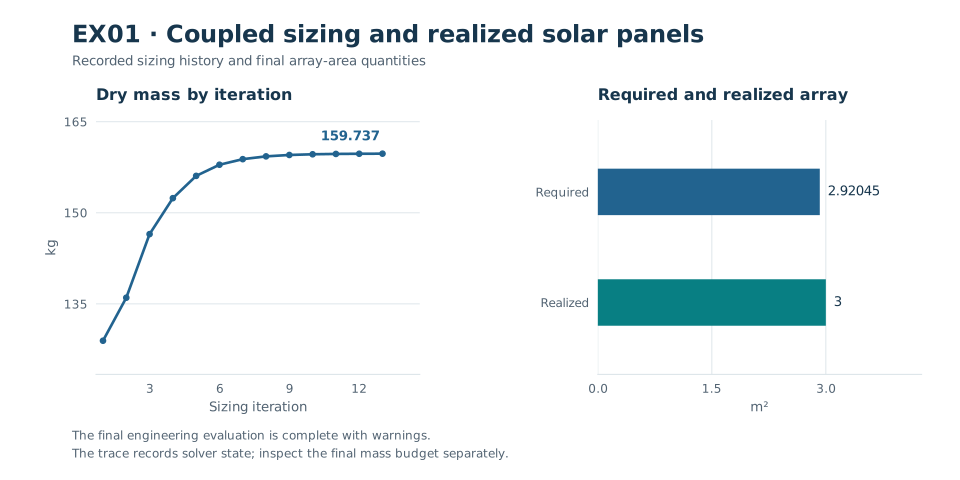
EX01's recorded study provides complete mass coverage and realizes 2.25 m² of array against a requirement of approximately 2.16 m². Its evaluation is complete with warnings. A settling trace alone still does not establish engineering closure; read the actual owning result and its assumptions. Read the recorded results and diagnostics together.
Use the final owning subsystem result for its reported budget. An iteration trace contains the changing system state and may include damping; its final row need not be numerically identical to a final subsystem result. Preserve that distinction when plotting or comparing quantities.
For a missing or failed result, follow the issues and unsatisfied prerequisites using the result-reading sequence. Keep that state in the comparison so an unavailable quantity cannot look like a zero budget.
For a defensible trade, hold unrelated inputs and resource versions fixed, execute every candidate and compare both budgets and assessment states. EX04 shows this process for two fixed topologies. See the convergence field reference for exact trace fields.