Lifetime and electrical degradation
Inspect retained capability in the Console
Open Sizing and budgets > Power for the Symmetric deployable arrays starter. In Required and installed, compare Usable battery energy with its required value, then read the Battery hardware card's Installed energy (BOL) and Usable energy (EOL). Expand Analysis context and sources for the recorded Array retention and Battery retention factors.
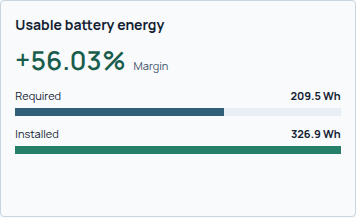
The comparison shows 326.9 Wh usable at EOL against 209.5 Wh required usable energy. The separate Battery hardware card records 900 Wh installed at BOL. The usable amount includes the storage accounting limits; its ratio to 900 Wh is not itself the battery-retention factor.
Use the factors to explain how capability changes, then follow their source identities into the lifetime record for individual driver values and default flags. The Console's Power view shows their effect on sizing; it does not provide a separate battery-aging timeline.
Size for the capability that remains at end of life
An array or battery that meets beginning-of-life demand may fall short later. The degradation calculation estimates retained electrical capability from the selected technology, service life and operating assumptions. Reliability and spacecraft survival need separate evidence.
Inputs include design life in years, orbit period in s, panel and battery technology, catalog degradation properties, uncertainty case, radiation case, battery depth of discharge and battery temperature assumption. Missing catalog properties may resolve to explicit policy defaults; review the factor ledger and source identity for every default.
Panel retention
The panel calculation separates time and radiation retention. Its time term is based on an annual degradation rate adjusted by the selected uncertainty case:
Here \(d_{\mathrm{annual}}\) is the adjusted annual degradation rate, \(L\) the design life in years and each \(R\) a dimensionless retained fraction.
Numerical bounds keep retained factors positive. The rate is a fraction per year; the exponent uses years. Radiation retention is a separate selected case/catalog term, not a second copy of the annual loss. BOL power multiplied by the resulting factor gives the corresponding modeled EOL capability before the other power-accounting factors.
Battery retention
The current cycle proxy assumes repeated orbital cycles:
\(s_{\mathrm{year}}\) is the adopted seconds per year, \(T\) the orbital period in s and \(D\) the depth-of-discharge fraction. \(N_{\mathrm{EFC}}\) counts equivalent full cycles.
Battery retention multiplies calendar, throughput, depth-of-discharge and temperature factors. The throughput term uses a catalog/policy cycle-life basis; calendar retention compounds with design life. The temperature term is a bounded empirical policy around its reference range, not an electrochemical simulation.
The battery temperature used for degradation is an authored/default degradation assumption. Do not imply that the final thermal node temperatures automatically replace it. Likewise, the orbital-cycle proxy does not reconstruct a detailed flight charge/discharge history.
Use in the integrated study
Panel retention affects available generation; battery retention and usable storage limits affect pack sizing and energy closure. Larger hardware can change mass, geometry and heater/operating demands. Read installed BOL Wh, retained EOL Wh and usable EOL Wh separately: multiplying rated Ah by a bus voltage does not establish usable pack energy.
The lifetime result records individual factors, driver values, source identities and default flags. The current integrated model retains a warning/degraded applicability. Include that status when reporting retained capability.
Failure and validity boundaries
Unsupported technology, invalid retention fractions, nonpositive cycle-life basis or unavailable environment period cannot be silently treated as a nominal case. A familiar technology label alone does not validate the coefficients for a specific battery or radiation environment.
Do not use these factors as proof of mission life, capacity recovery, thermal runaway protection or chemistry equivalence. In particular, future Ni-H₂ or resistojet mission studies need appropriate hardware/model applicability rather than renamed generic parts.
Use EX02 to follow the lifetime warning into EPS, then review power storage and recharge.