Launch accommodation screening
Review accommodation in the Console
Open Spacecraft > Launch. The Symmetric deployable arrays starter uses a user-authored custom envelope, making the distinction between screening and sourced launch requirements especially visible.
Select the mass case and comparison
Read Selected accommodation before choosing Nominal under Launch mass cases. Under Demand versus limit, select geometry u span for a physical dimension comparison. Review the displayed margin convention, then inspect the other spans and the separation-system checks. Inspect stowed CAD opens the geometry state used for accommodation.
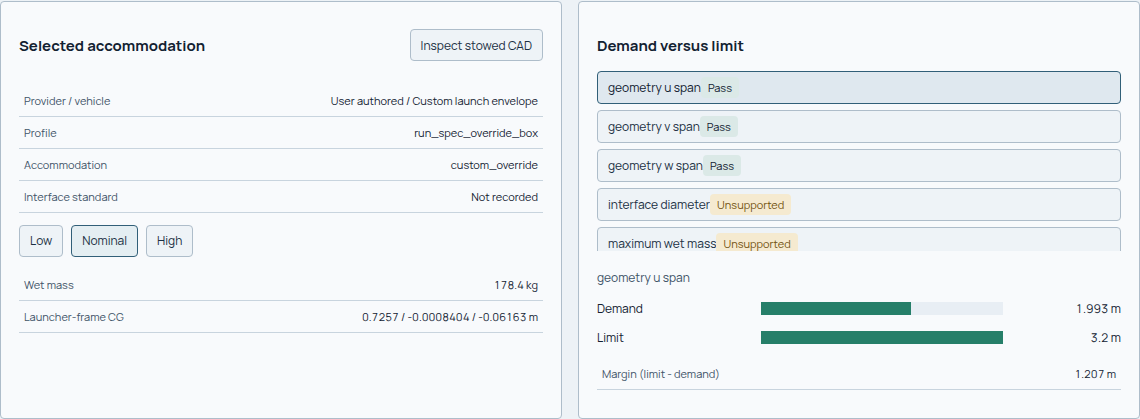
The nominal launch case retains 178.4 kg wet mass. The selected custom envelope supplies geometry limits; it does not supply every mass, CG or environmental requirement a launcher provider would impose.
Keep unsupported checks and qualification visible
Read Engineering checks below the comparison. Unsupported identifies a check whose necessary requirement or evidence is absent. Continue to Qualification and expand Required follow-up for a discipline such as random vibration, coupled loads or separation dynamics.
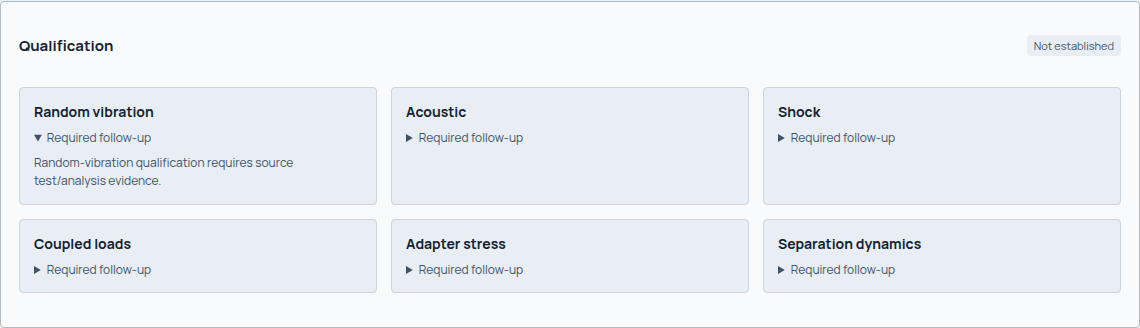
This run reports screening pass with 0 required checks failed, while launch qualification remains Not established. The visible unsupported checks explain why those statements can coexist.
Choose the launch profile to screen
A spacecraft may fit the fairing and still exceed a separation-system mass or
CG limit. Launch screening evaluates the represented launch state against one
explicit profile and its sourced requirements. Select a maintained profile with
launch_accommodation.selected_envelope_id, or supply an explicit_envelope.
An allowed list is a selection boundary, not a request to recommend the best
launch service. Multiple allowed profiles still require an explicit selection.
A custom box is user-authored authority for that run. It does not acquire provider backing. Maintained dimensions may also be bounded approximations: a conservative polygon or context-only cylinder is not an exact contoured keep-in volume. Read field-level authority and limitations.
State and checks
Screening uses the stowed, beginning-of-life wet spacecraft state, including stowed articulated geometry and separation hardware. The state projection records the body-XYZ to launcher-UVW transform, interface plane and aligned low/nominal/high wet mass, CG and inertia cases. Only the nominal mass case is the convergence state; side cases vary mass-policy contributions.
| Check family | Demand/limit and units | Interpretation |
|---|---|---|
| Geometry | Complete stowed spans/keep-in boundary, m | Depends on represented shape and orientation |
| Interface | Diameter in m or exact named standard | A named bolt-pattern identity is not a circular diameter approximation |
| Mass and CG | Wet mass in kg; axial/lateral CG in m | Includes the selected state and separation-system limits |
| Equivalent loads | Force in N, moment in N·m | Uses sourced quasi-static load factors and CG lever arms |
| First frequency | Frequency in Hz | Uses available evidence or a bounded equivalent single-degree-of-freedom estimate |
For a sourced load factor \(n\) in multiples of standard gravity:
Equivalent overturning moment combines forces with the corresponding CG distances. An equivalent frequency estimate uses:
Here stiffness \(k\) is in N/m and effective mass \(m_{\mathrm{eff}}\) in kg, giving frequency \(f\) in Hz. These reductions do not replace coupled structural dynamics.
Read every disposition
Each check records demand, limit, signed margin, units, margin convention, requirement, sources and authority.
| Disposition | Meaning |
|---|---|
pass |
Evaluated sourced native requirement with nonnegative margin |
fail |
Evaluated sourced native requirement with negative margin |
informational |
Useful calculated demand without a requirement-closure claim |
unsupported |
Required data or specialist analysis is unavailable |
Read the recorded margin convention: an upper limit and a minimum frequency have different directions of compliance. The aggregate uses required native checks; unsupported items remain visible and do not become passes.
A named interface standard must match exactly; a missing or different required standard fails that check. The retained diameter may be context only. Adapter strength and installation qualification still require their own evidence.
Coupling and limits
EX03 completes execution while failing a separation system mass limit. A larger geometric box would not solve that requirement. EX05 skips launch because its required mass properties are unavailable; that is not an assessed launch pass or fail.
Random vibration, acoustics, shock, coupled loads, adapter stress and separation dynamics remain specialist handoffs. Qualification stays not established even when every supported native check passes. The model supports concept/PDR screening, not provider acceptance.
Use the launch result reference to locate individual checks and handoffs, and retain their authority when summarizing a candidate.