Communications and data delivery
Inspect a link and its service in the Console
Open Sizing and budgets > Communications. The Symmetric deployable arrays starter records TT&C uplink and downlink paths. It provides a useful distinction between a passing link budget and an unassessed data service.
Select a path and review its margin
Select TT&C down under Communication paths, or choose its bar in Link margins. Read Daily data return beside the link result before assuming that a positive dB margin proves the mission can return its data.
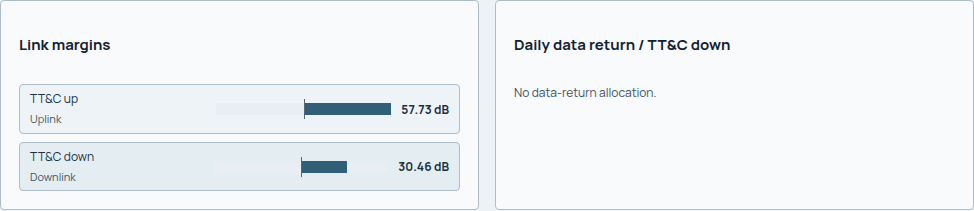
The TT&C downlink has 30.46 dB above its required design margin, but this run records No data-return allocation. The missing service assessment is visible alongside the passing path.
Read the budget and loss terms
In the TT&C down link budget table, compare Available link margin, Required design margin and Margin above requirement. Continue through rate, range, EIRP, carrier/noise quantities and the RF loss contributions plot. Switch to TT&C up to inspect the other direction on its own basis.
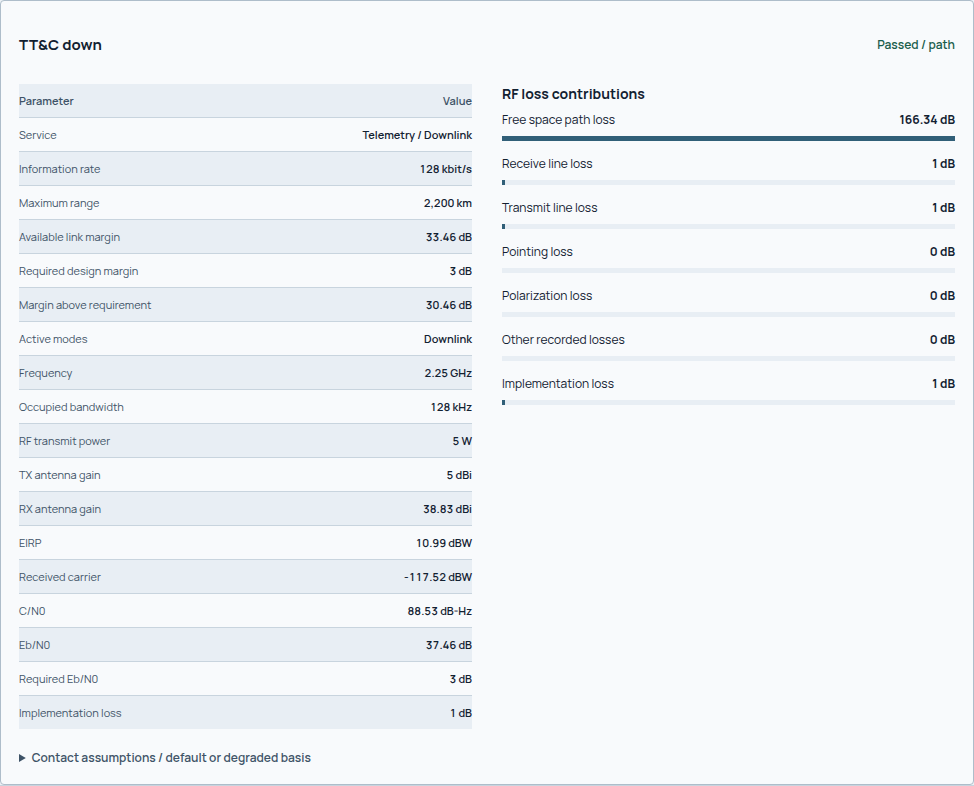
For the captured 128 kbit/s downlink at 2,200 km, 33.46 dB available minus 3 dB required leaves 30.46 dB. The loss plot exposes the terms behind the link; it does not describe transmitter electrical consumption.
Check contact assumptions and storage coverage
Open Contact assumptions / default or degraded basis, then read Path checks and storage. A recorded contact model may supply time and availability assumptions even when the run has no data-volume or storage-demand assessment. Use Open checks and evidence to investigate the recorded scope.
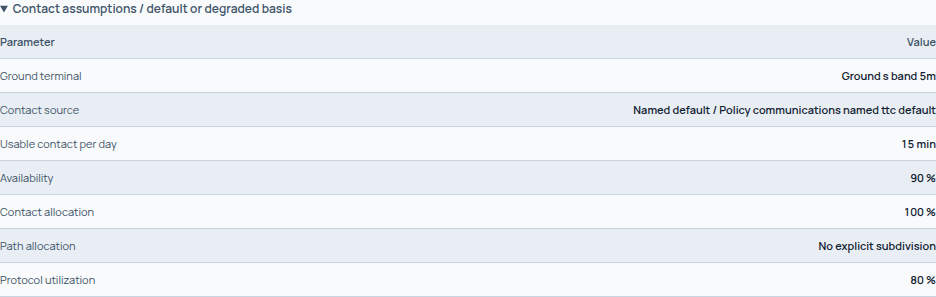
The named contact default supplies 15 min per day, 90% availability and 80% protocol utilization. The run still leaves Daily data return Not assessed and records no storage-demand assessment. Author and assess the intended service before using its RF margin as evidence of complete communications closure.
Check the link, then the data service
A usable radio link is the first check. Contact time, generated data and the longest gap also determine whether the mission can deliver and store its data. Sindri evaluates the configured link and aggregate delivery capacity. Define service/direction, RF or supported optical technology, information rate, hardware roles, ground terminal, contact case and generated data. Complete mission plans need the required command and telemetry paths, not just the highest-rate payload downlink.
Use Hz for RF frequency, bit/s for information rate, W for RF/optical output, K for receiver noise temperature, and explicit dB gain/loss terms. Electrical transmitter consumption is a separate operating load. Keep symbol rate, information bit rate and occupied bandwidth distinct.
RF budget
For range \(r\) in m and wavelength \(\lambda\) in m, the implemented free-space loss is:
The logarithmic link budget then uses:
\(C\) is received carrier power, \(N_0\) receiver noise density and \(R_b\) the numerical information rate in bit/s. The final margin \(M\), implementation loss and required margin are all in dB.
Antenna gains add and line, propagation, polarization and pointing losses subtract at their stated stages. Noise density follows kT. An aperture-derived gain includes aperture efficiency; it is not simply geometric diameter.
A contact may use a supplied range or an analytic spherical-Earth slant range at the elevation mask. This does not propagate chronological ground passes. The loss ledger and selected receiver matter for direction: uplink and downlink have different transmitters and noise temperatures.
Contact and storage closure
A passing physical link provides aggregate capacity:
Contact time \(t_{\mathrm{contact}}\) is in s/day. Availability, allocation, path allocation and protocol utilization are dimensionless fractions, so the delivered volume and volume margin \(M_V\) are in bit/day.
A failed link contributes zero delivery in this calculation. Sources supply either daily volume or generated rate with active duration. Storage demand is assessed only when a maximum gap is supplied, with the source's backlog reserve. A nonnegative daily margin without a maximum gap retains an unassessed storage condition/warning. It does not prove chronological buffer closure or latency.
Hardware mass and mode electrical loads feed the system's mass and EPS budgets. The same RF output can correspond to very different electrical consumption for different hardware. Preserve the hardware identity when coupling these results.
Optical and service boundaries
The supported optical model is far-field link screening using divergence, apertures, efficiency, sensitivity and declared losses. It does not establish acquisition/tracking availability, weather service, turbulence or a validated optical operations concept. Do not transfer a ground-link pass to an inter-satellite service without the appropriate model and configuration.
Read results and limitations
The communications result contains path link budgets, margin-to-requirement, data closure, resource/mode loads and controlling reasons. A path pass applies to its configured model and requirements; it is not measured service availability.
EX01 has a passing communications assessment while other subsystems fail. EX03 retains a communications warning. Review the recorded reason and contact/storage assumptions, rather than using a spacecraft-level completion label as a service claim.
Unavailable hardware parameters, incompatible roles, invalid losses/rates or missing required paths need correction or explicit unsupported scope. Current hardware resources and model authority must be checked before reconstructing a real mission; an approximate radio label is insufficient.