Cost estimates and engineering authority
Follow an estimate to its basis in the Console
Open Cost for a completed run. The Symmetric deployable arrays starter illustrates the difference between a computed ledger, its uncertainty range and the evidence behind individual lines.
Find the main drivers
Read the headline range and Build quantities, then Main cost drivers. Each ranked bar is selectable. Choose Development NRE to inspect the largest contribution in this study. Keep the reporting currency and price year from Estimate scope, quantities and currency basis with any exported amount.
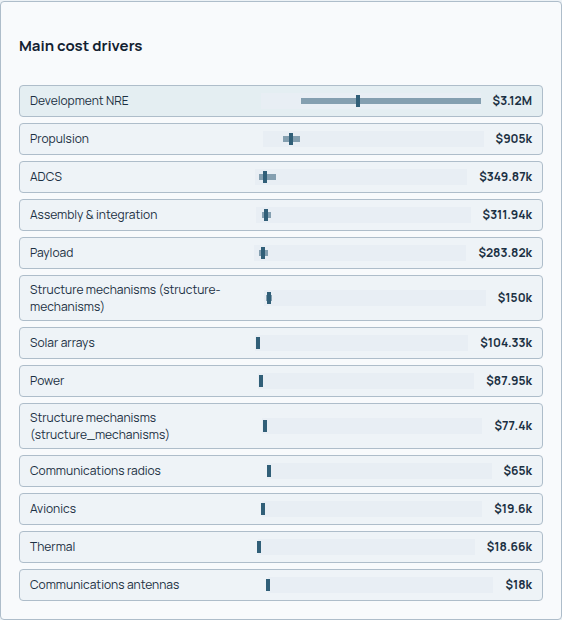
The display reports a $5.51M base estimate and a \(2.76M–\)10.68M range. Its 23/23 resolved cost lines describe coverage of the recorded ledger, not confidence in those amounts or coverage of every mission expense.
Separate recurring hardware from development
Use Recurring and development cost to distinguish amounts repeated with hardware production from development NRE. Check Build quantities before comparing this total with another run or applying a per-unit interpretation.
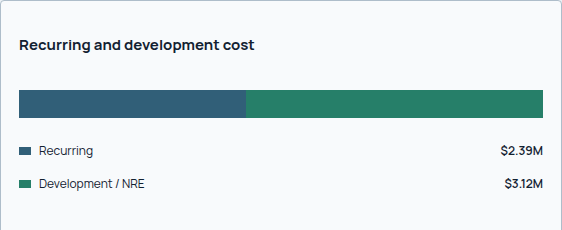
The recorded base splits into $2.39M recurring and $3.12M development/NRE for 1 flight, 0 spare and 0 qualification articles. Development is not an additional amount to add to the displayed total.
Open the selected line's evidence
Under Development NRE, expand Estimate basis and source. Read the derivation, evidence tier and source references. Select other Cost groups to distinguish catalog pricing, modeled allocations and unresolved pricing, where present; Associated system hardware is shown only when a mapping was recorded.
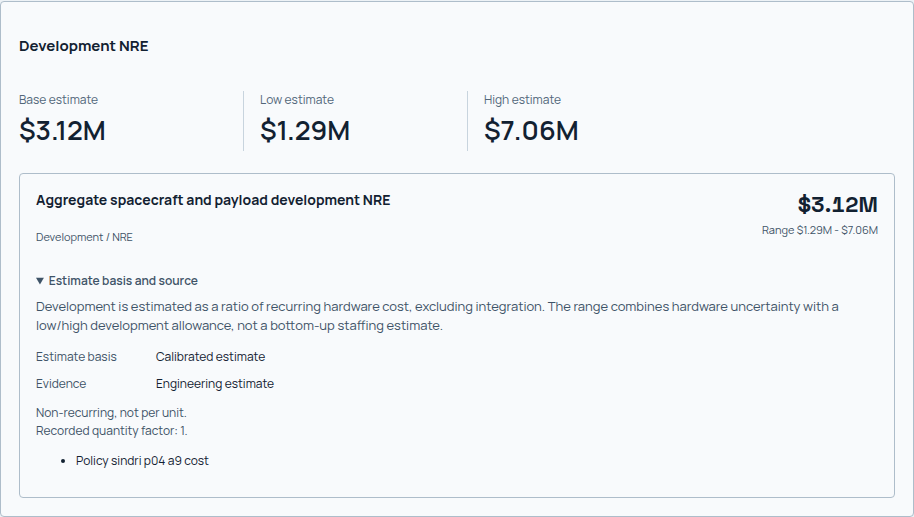
The selected NRE line is an aggregate development estimate. Its source explains how it was derived; a cost allocation is not a physical part or a staffing plan.
What the estimate covers
Sindri's deterministic concept/PDR cost estimate is a low/base/high ledger for spacecraft and payload flight hardware, carried launch-interface/separation hardware, assembly/integration/test and program allowance, and development NRE. It excludes launch service, ground segment, operations, replenishment, disposal and lifecycle operations. It is neither a procurement quotation nor a staffing, schedule or funding model.
Every amount includes currency and price year. Missing mandatory amounts remain unresolved; they are not zeros. Read inclusions, exclusions and calculation status before presenting a grand total.
Resolution and accounting
The recurring ledger follows selected/resolved hardware. Depending on policy,
it uses an explicit component override, upstream hardware amount, selected
catalog, bounded archetype scaling or parametric fallback. catalog,
parametric and hybrid choose the permitted resolution route. Strict catalog
or evidence settings may make otherwise calculable lines incomplete.
Canonical accounting uses USD 2025, including the convergence metric. Reporting currency/year is a separate normalization. Offline FX/escalation data is the default; an opt-in materialized ECB snapshot can replace only the internal-to-reporting FX step. It does not change original source-price normalization, internal accounting, convergence or escalation. Unsupported currencies/years fail explicitly.
Flight, spare and qualification quantities define repeated hardware articles. A bounded Wright learning policy applies to recurring hardware up to its supported article count. The cumulative factor is greater than one and less than the undiscounted count for multiple articles. NRE does not receive learning. The AIT/program allowance is included once from extended hardware cost, rather than multiplied a second time by article count.
Aggregate NRE uses a bounded ratio on single-article recurring hardware. Explicit NRE lines replace that aggregate; the two cannot be combined. The grand total reconciles recurring and non-recurring ledger contributions once each.
Cross-check and uncertainty
The SSCM96 dry-mass relationship is a separate public calibration cross-check within its declared applicability range. It is normalized to the same monetary basis, but is never added to or averaged into the native estimate. If applicable intervals do not overlap, a separate calibrated envelope spans them while retaining the native base. An inapplicable cross-check cannot improve the native estimate's authority.
Low/base/high ranges are bounded engineering policy/evidence ranges, not probabilistic confidence intervals. Technical component evidence does not establish current price or supplier availability. The illustrative-study totals remain engineering estimates, even when every ledger line computes.
Read authority separately from applicability
| Evidence tier | Meaning |
|---|---|
verified |
Inspectable primary/supplier evidence with field-level review |
credible |
Reviewed engineering basis with remaining field-level evidence limits |
engineering_estimate |
Transparent bounded archetype or method estimate |
policy_default |
Explicit policy choice, not measured hardware/physics evidence |
unknown |
No adequate authority; do not substitute zero or nominal |
An authority's field evidence map identifies which claims a source supports.
Applicability (applicable, degraded, unsupported) and limitations remain
separate. A verified component can be inappropriate for a selected role or
class; a model with a stable version can still lack independent validation.
Run provenance records the authority/resource revision. If the available local registry does not match a saved run's digest, an availability note is preferable to applying today's authority metadata to yesterday's numbers.
Review the estimate before quoting a total
Cost computed means mandatory lines resolve under the selected policy.
incomplete retains unresolved amounts or evidence-threshold failures; it may
coexist with a completed run. failed means no valid bounded result can be
produced. Use the ledger sources and estimate basis to state how much confidence the
total warrants.
Inspect ledger sources, quantity/learning evidence, unresolved IDs, tier counts, monetary basis and cross-check applicability. Use the cost projection reference and cost payload in the result envelope. A later model/catalog change requires its own applicability and evidence review.