EX03: larger-payload integrated design
All examples and learning routes
This study carries an 80 kg payload with 25/50 W authored demand and a 120 m/s electric-propulsion allocation. It is the CLI counterpart of EX09. Its historical directory name includes “low-kw”; the maintained lesson concerns a larger payload and integrated budgets, not continuous kilowatt payload operation.
Prepare and run
Download EX03, extract it and run from EX03:
sindri validate-project baseline/study.yaml
sindri run baseline/study.yaml --output-root runs
Use a compatible runtime and CAD backend. Expect a completed run, complete evaluation with warnings and all required hardware placed. Preserve actual input and result hashes when comparing runs.
Inspect the engineering consequences
The 2.0 × 0.8 × 1.2 m reference bus retains room for the authored payload and catalog equipment. In Mass, inspect the payload contribution separately from structure, harness and subsystem estimates. In Power and Thermal, compare array area, battery energy, heater demand and radiator area; these quantities have different units and cannot be read as a single resource margin.
In Spacecraft, verify the fixed panels fit their supporting faces and the thermal panel is exterior. Hide the bus envelope to inspect the decks and their harness cutouts. In Launch, read the high mass case and selected separation system as well as the envelope checks.
The representative beta angle is 60°. This is a different mission from EX01, so differences between their budgets do not isolate payload mass alone. Use EX04 for a controlled layout comparison.
Verified results
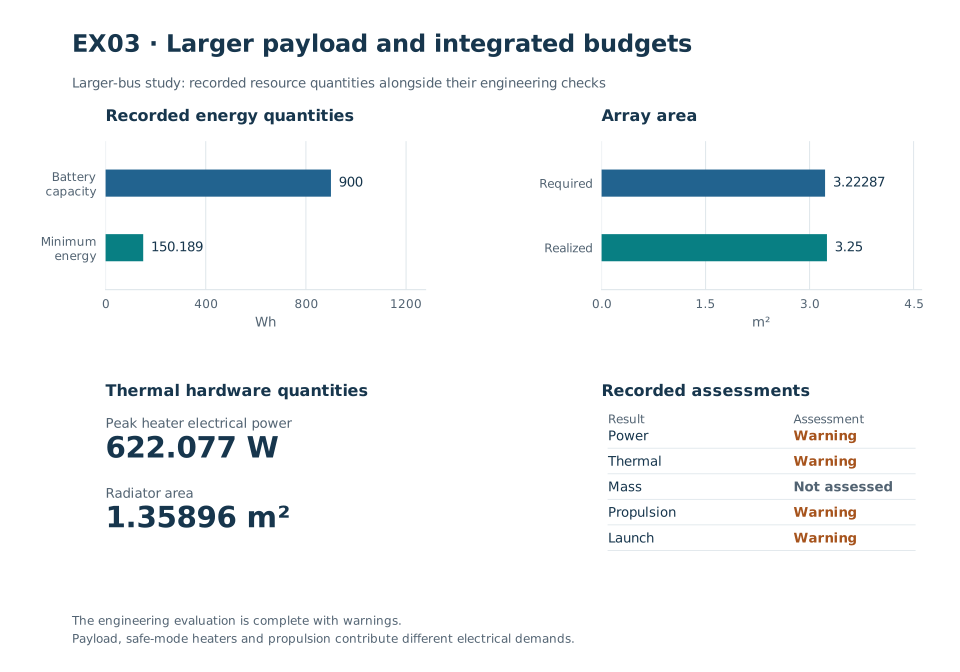
Read battery energy, array area, heater demand and radiator area alongside their recorded assessments. This is a larger-payload case, not a claim of continuous kilowatt payload operation.
The following values are generated from the verified observations. Read the assessment states before treating any reported quantity as a usable design budget.
baseline — run lifecycle: completed.
| Quantity | Observed value | Unit |
|---|---|---|
| Nominal dry mass | 251.538 | kg |
| Required solar array area | 3.22287 | m² |
| Realized solar array area | 3.25 | m² |
| Minimum state of energy | 150.189 | Wh |
| Peak heater electrical power | 622.077 | W |
| Radiator area | 1.35896 | m² |
| Loaded propellant | 2.09508 | kg |
| Total delta-v | 120 | m/s |
| Communications hardware mass | 1.15 | kg |
| Battery capacity | 900 | Wh |
| Reported cost estimate (base) | 6.24889e+06 | USD (2025) |
Full result states, diagnostics and provenance.
Limits
The generous reference envelope is not optimized. Equipment boxes, distributed mass policies and gross deck areas do not establish detailed installation or manufacturing mass. Read shared example limits before changing mission requirements or interpreting a score as design approval.